
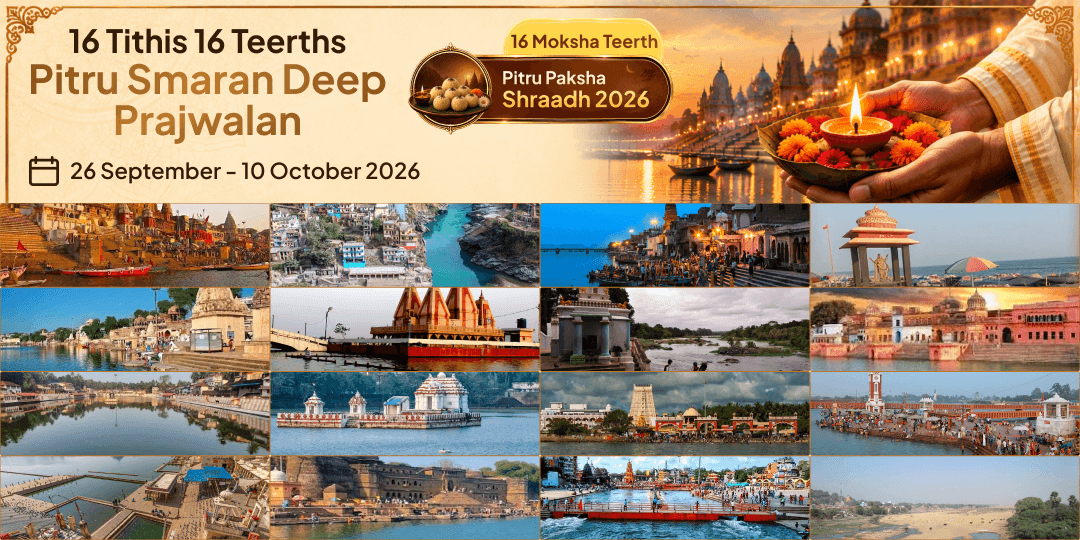
Pitru Paksha 16 Tithis 16 Teerths Pitru Smaran Deep Prajwalan
The Shraddh Vidhi itself prescribes Raksha-Deep Prajwalan as part of ancestral duty, the Diya is a personal flame of remembrance and protection placed at a sacred crossing. Each of the 16 Teerths in this seva has been chosen because its specific divine significance corresponds directly to the tithi and the ancestral need that day carries.
Deep Prajwalan across 16 Teerths on all 16 Tithis:
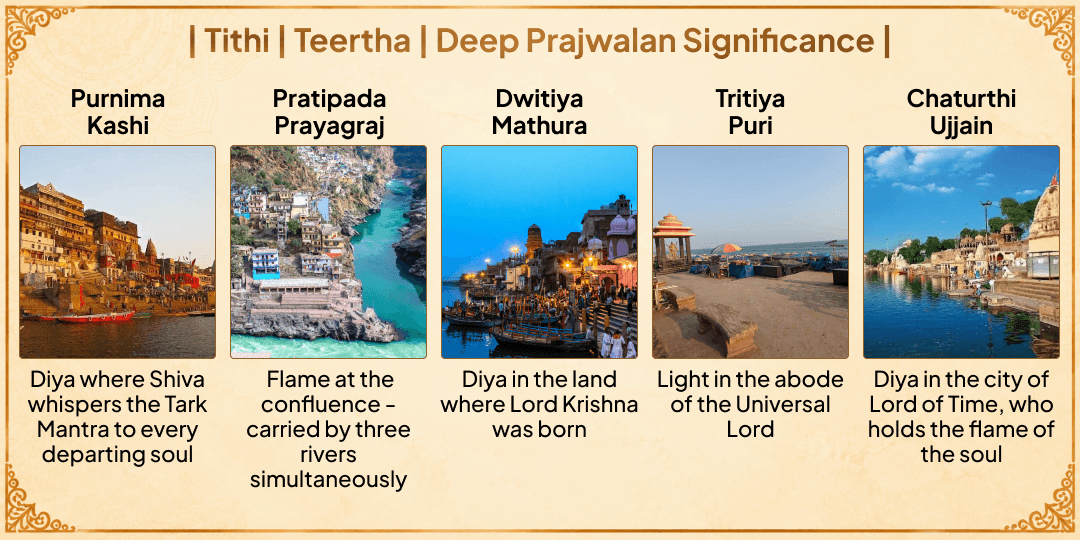
🔱 Purnima (Kashi): Where Shiva whispers the Tarak Mantra to every departing soul. The flame of Pitru Paksha begins in the city where no soul is ever lost.
🔱 Pratipada (Prayagraj): Triveni Sangam, the King of all Tirthas. A flame at the confluence, carried forward simultaneously by three sacred rivers.
🔱 Dwitiya (Mathura): The birthplace of Krishna, where Vishnu's liberating grace is most immediate. A Diya lit in the land where the divine entered the mortal world.
🔱 Tritiya (Puri): The abode of Jagannath, the Universal Lord who holds all creation within him. A flame lit in the presence of the one who contains everything.
🔱 Chaturthi (Ujjain): The city of Mahakal, Lord of Time - the one deity who holds authority over the moment of every birth and every death. A Diya in the city where time itself bends toward liberation.
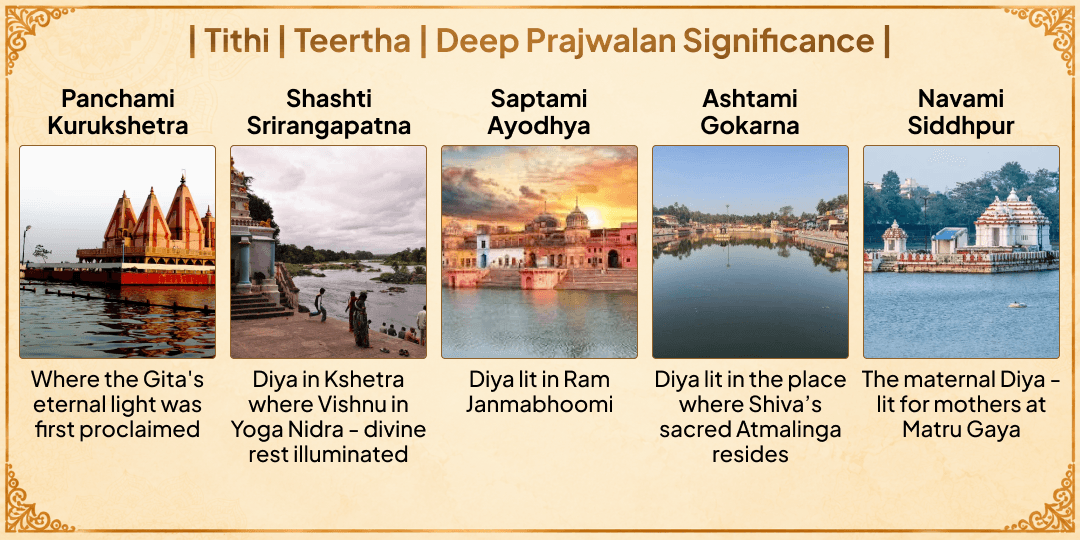
🔱 Panchami (Kurukshetra): The sacred battlefield where Krishna declared the Bhagavad Gita, the eternal light of dharma first proclaimed to the world. A flame lit where the truth of the soul's immortality was first spoken aloud.
🔱 Shashti (Srirangapatna): The Kshetra where Vishnu rests in Yoga Nidra - divine, eternal rest. A Diya lit in the presence of the Lord who never truly sleeps, only rests between one act of grace and the next.
🔱 Saptami (Ayodhya): Ram Janmabhoomi, where Lord Ram was born, where dharma took its most complete human form. A flame lit in the city that carried the weight of the world and never let it fall.
🔱 Ashtami (Gokarna): Home to Shiva's sacred Atmalinga, one of the most powerful and difficult to reach Teerths in all of Hinduism. A Diya lit where Shiva's own essence resides in the earth.
🔱 Navami (Siddhpur): Matru Navami, the tithi of maternal ancestors. Bindhu Sarovar in Siddhpur is Matru Gaya, prescribed specifically for mothers and the maternal line. Diya lit for every mother who was never formally honoured.
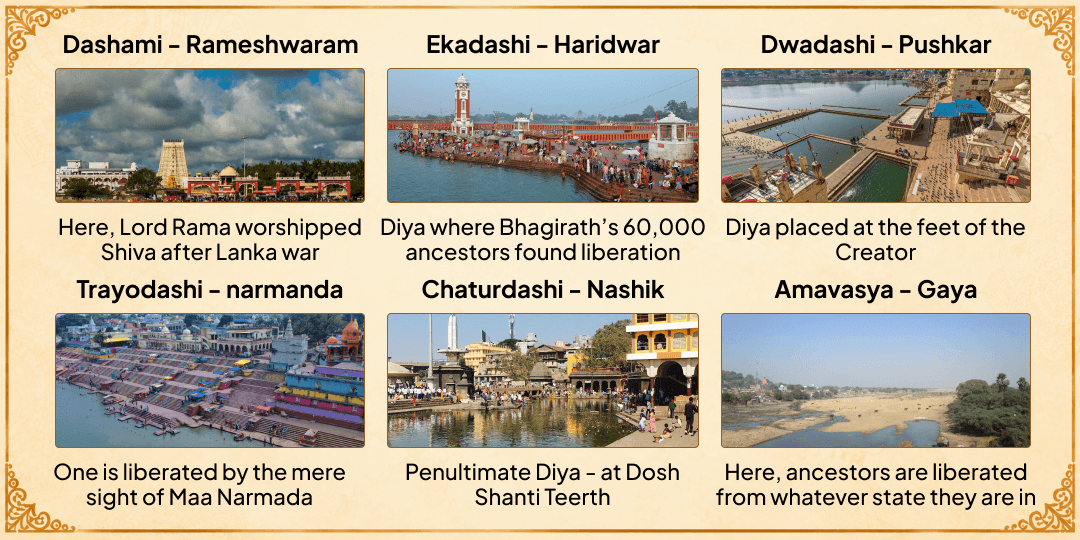
🔱 Dashami (Rameshwaram): Where Lord Ram worshipped Shiva after the Lanka war, and where Shiva and Vishnu's grace converge in one sacred geography. A flame lit where the Lord himself once stood in the act of devotion and remembrance.
🔱 Ekadashi (Haridwar): Where King Bhagiratha's prayer brought the Ganga to earth and freed 60,000 ancestors. By this rite, the scriptures declare, ancestors up to twenty-one earlier generations are redeemed. A Diya lit where the impossible was once made possible by the force of a single act of remembrance.
🔱 Dwadashi (Pushkar): The lake born from Brahma's lotus, home to the rarest Brahma temple in creation. A flame placed at the feet of the Creator himself, the one who set the cycle of birth, death, and return into motion.
🔱 Trayodashi (Narmada Ghat): One attains Moksha (liberation) by the mere sight of Maa Narmada. A Diya lit at the place invokes the same grace.
🔱 Chaturdashi (Nashik): The penultimate Diya at the Dosha Shanti Teerth, where accumulated karmic burden is specifically addressed in the tradition. The flame that prepares the ancestor for the final crossing.
🔱 Sarv Pitru Amavasya (Gaya): The Garuda Purana declares: whoever performs Pitru Karma at Gaya liberates their ancestors from whatever state they are in. The final flame of Pitru Paksha, lit at the Teerth where every ancestral journey, however long and complicated, finds its resolution.


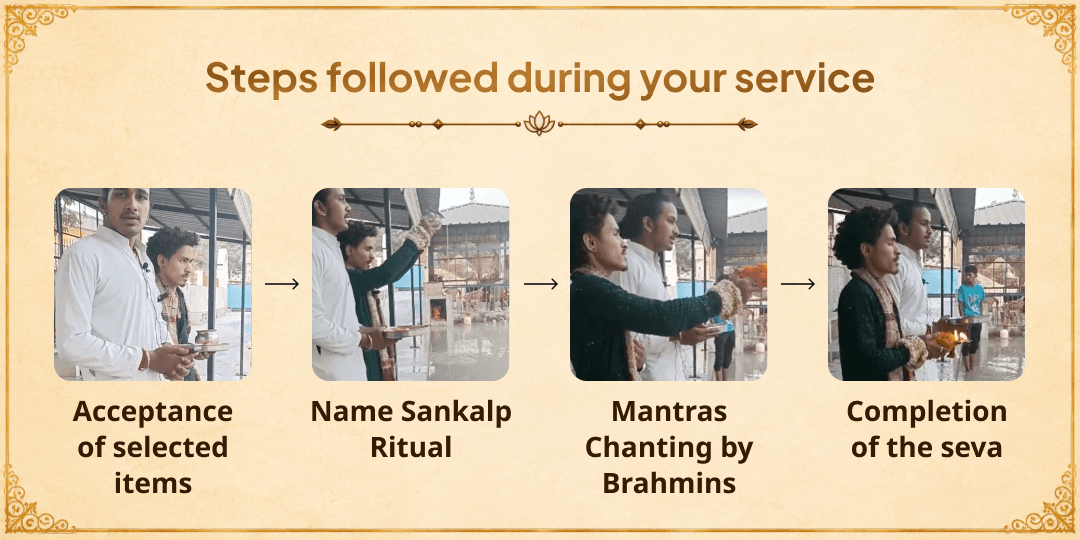
Through the Sri Mandir Chadhava Service App, your offering will be devoutly presented by our experienced Purohits. You will receive a video of the ritual within 24-48 hours, bringing you divine blessings and prosperity.
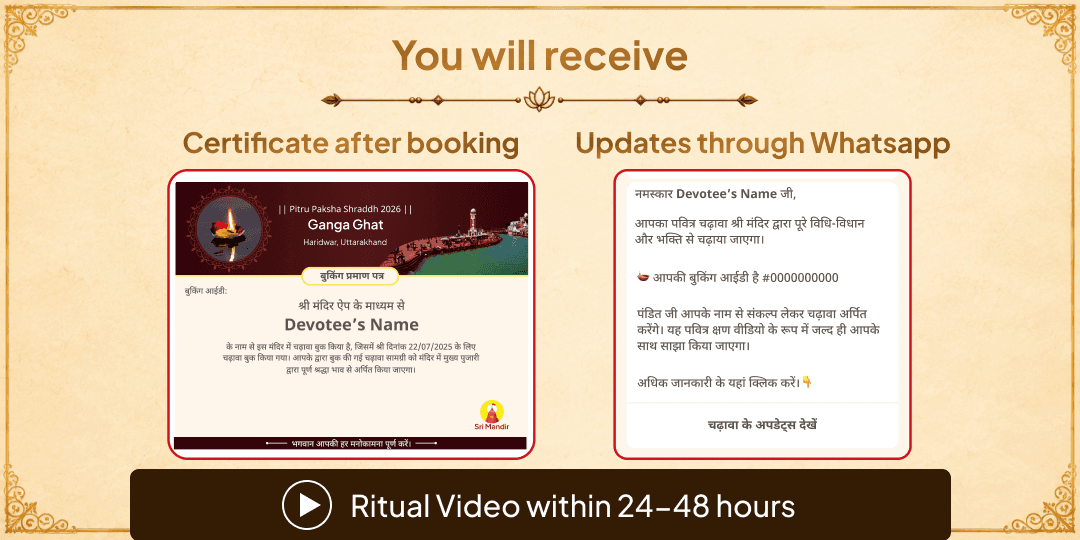
Yes, once you book an offering, you will receive a certificate immediately. You can view your certificate under the 'Services' page in the 'Your Bookings' section.
After booking, you will receive updates via WhatsApp. Additionally, you can check the complete details of your offering in the "Chadhava Bookings" section of the Sri Mandir App.
Sri Mandir is an App that allows you to book chadhavas at more than 100 renowned temples across India from the comfort of your home. You can select multiple options and include them in a single order.
If you face any issues with your Service, you can contact our Sri Mandir customer service team at 📞918296948051, who are always ready to assist you.