
Pitru Paksha Shraddh Purnima Pitru Dosha Shanti Pancha Maha Yajna
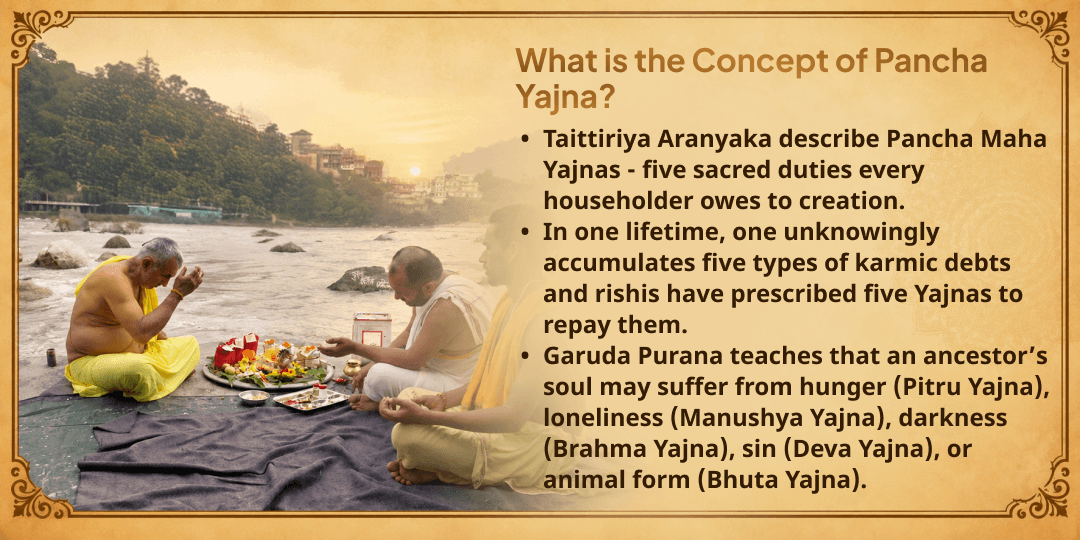
Shraddh Purnima is the moment to act as Pitru Paksha begins, Yamraj himself opens the gates of Pitru Lok. But Pitru Dosha that has accumulated across generations cannot be resolved by a single act at a single place. The Taittiriya Aranyaka prescribes Pancha Maha Yajnas - five sacred duties every householder owes to creation. This is why this Seva performs all five. Pancha Maha Yajna: Five Yajnas, Five Debts Cleared
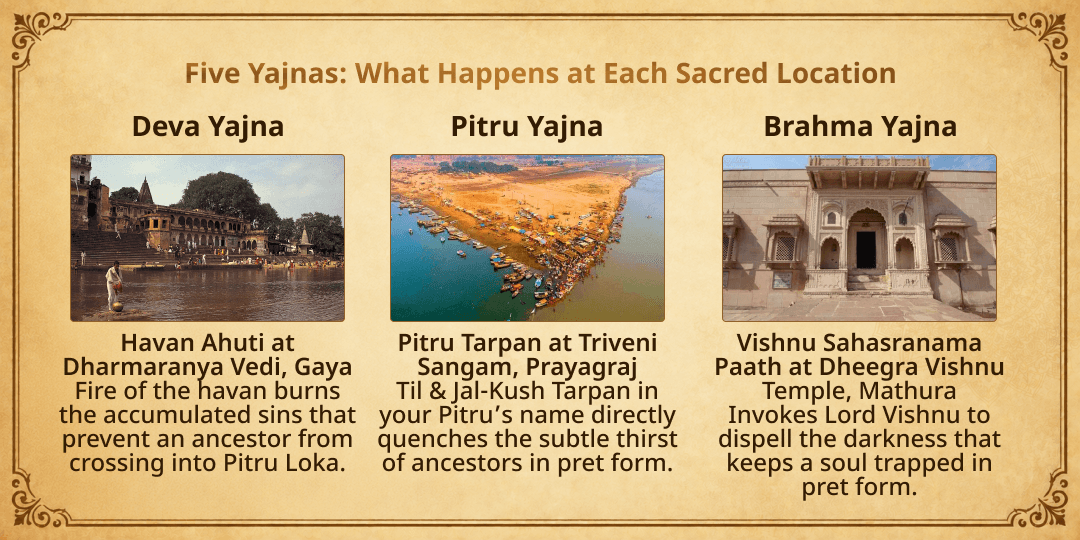
Brahma Yajna - Vishnu Sahasranama Path at Dheegra Vishnu Temple, Mathura
The ancestor's soul trapped in Pret form suffers most from darkness, the inability to see the path forward. Vishnu Sahasranama Paath invokes the direct grace of Lord Vishnu to dispel that darkness. The Paath performed here does not merely pray for your ancestor, it illuminates the path they have been unable to find.
Deva Yajna- Havan Ahuti at Dharmaranya Vedi, Gaya>
Accumulated sin is what prevents an ancestor from crossing from Pret-yoni into Pitru Loka. The Havan at Dharmaranya Vedi in Gaya, one of the 45 sacred Pinda Sthanas of the Gaya Kshetra, is prescribed specifically for this. The fire of the Havan here does not merely purify, it burns the karmic residue that has held your ancestor at the boundary.
Pitru Yajna - Pitru Tarpan at Triveni Sangam, Prayagraj
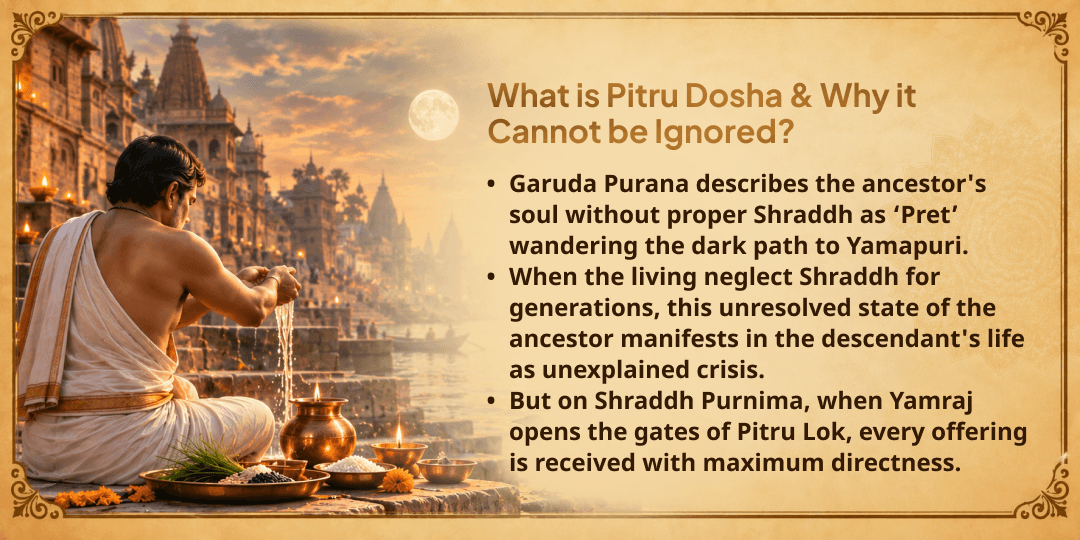
Garuda Purana describes the ancestor in Pret form as suffering from a subtle thirst that no water in the mortal world can quench, only Tarpan offered in Pitru’s name with Til, Jal and Kusha. Triveni Sangam - Tirthraj, where Ganga, Yamuna, and Saraswati converge is prescribed in the Agni Purana for Akshaya Punya.
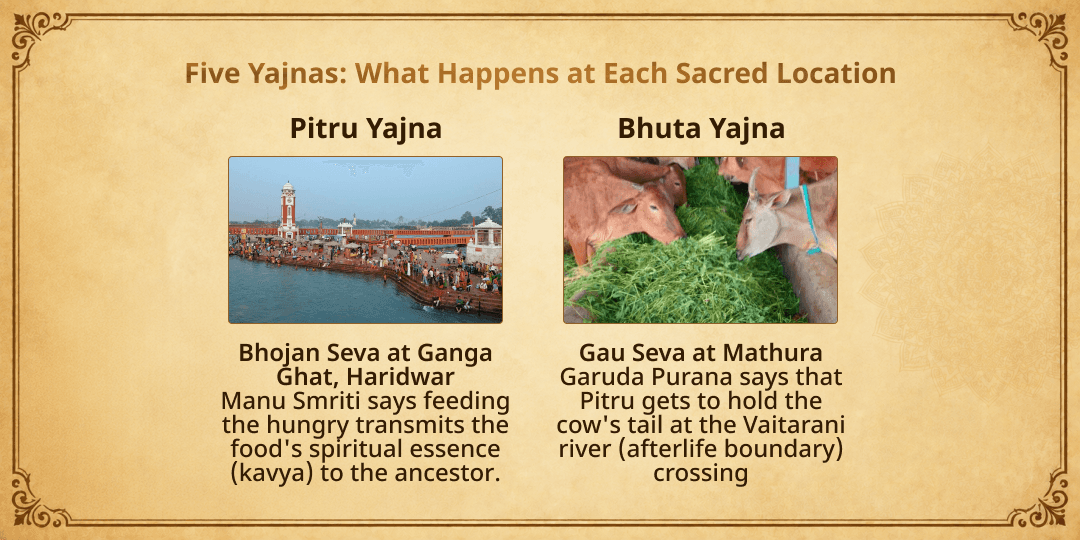
Manushya Yajna - Bhojan Seva at Ganga Ghat, Haridwar
The ancestor in Pret form suffers from loneliness, from the ache of being forgotten by those they loved. Manushya Yajna, the duty owed to fellow human beings, is fulfilled through feeding the hungry.Manu Smriti teaches that the spiritual essence of food, Kavya travels through the Brahmin's mouth directly to the ancestor. On the banks of the Ganga at Haridwar, where Bhagiratha's prayer once freed 60,000 souls, Bhojan Seva offered today carries your remembrance to your ancestor as nourishment.
Bhuta Yajna - Gasev at Shri Dham Gaushala, Mathura
Garuda Purana describes the Vaitarani, the great river of the afterlife that every soul must cross on the journey to Yamapuri. For the ancestor for whom Gauseva is performed by a descendant, the Garuda Purana promises they will cross holding the cow's tail. Without it, the crossing is alone.
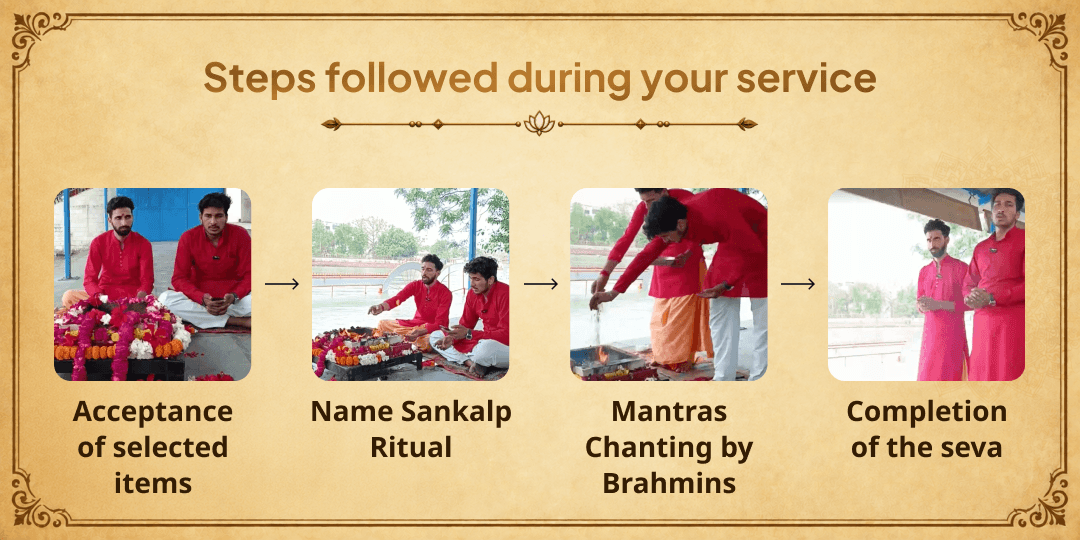
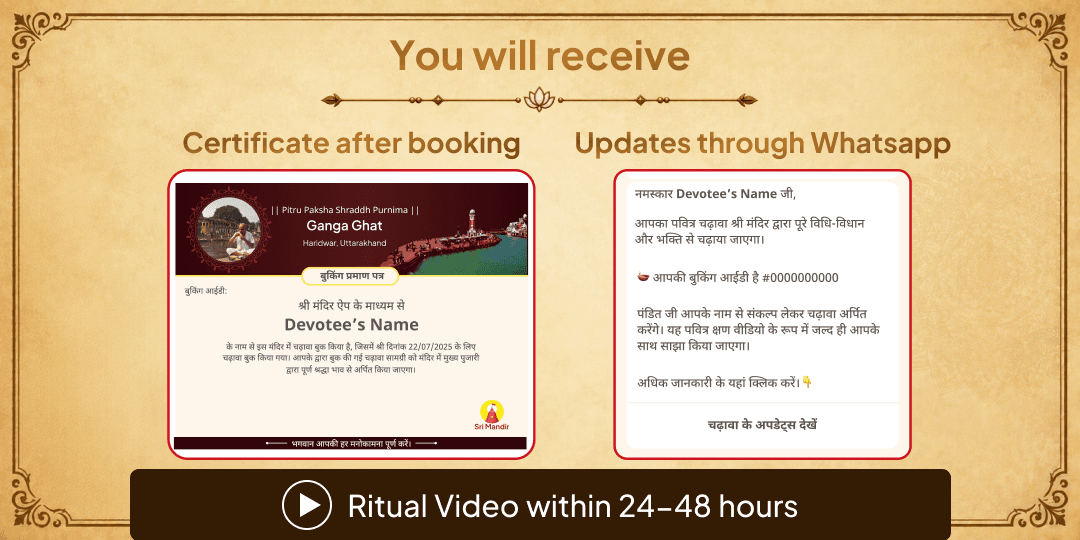
Through Sri Mandir App, all five Yajnas will be performed simultaneously across five sacred sites on Shraddh Purnima itself, by temple Purohits at each location. A video of the complete Seva reaches you within 24–48 hours.
Generations left this unfinished. You are the one who turned around - Book Now!


The Garuda Purana clearly states that ancestors reside in Pitru Loka in a “vayu-rupa” (air-like form) and return to their descendants during Pitru Paksha. The ancestors are said to reside in Chandraloka, and during Pitru Paksha, the distance between Earth and the Moon is at its shortest, both scientifically and spiritually. On Purnima, when the Moon is full, the ancestors are believed to be at their most active and receptive. This is the science of Shradh - when a descendant remembers their ancestors with a Sankalp in their name, the invitation is believed to reach that soul.
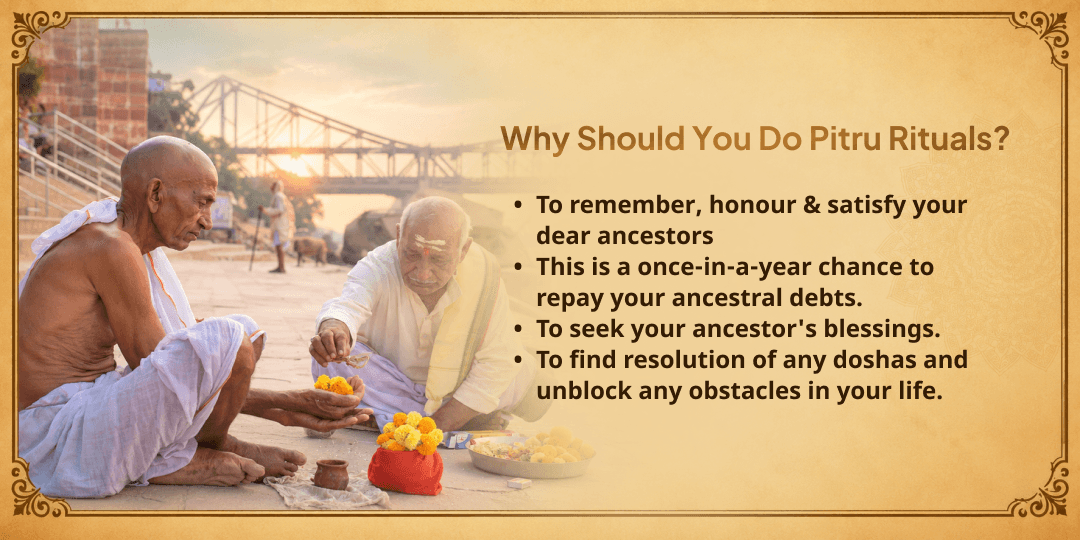
Every human being is born with five debts, among which Pitru Rin is considered the greatest. If it is not fulfilled through Shraddha and Tarpan during Pitru Paksha, it gradually takes the form of “Pitru Dosha.” To a greater or lesser extent, everyone carries some form of Pitru Rin in their life. However, in families that regularly perform Pitru rituals, this Dosha is believed to remain inactive. In families that have not performed Shraddha for several generations, this Dosha is believed to become more prominent.
Yes, absolutely. It is a major misconception that only men can perform Shraddha. The Ramayana provides an example: when Rama and Lakshmana went to collect the required materials, Mata Sita performed Pind Daan for King Dasharatha alone on the banks of the Phalgu River. This Shraddha was so powerful that Rama’s Sankalp letter became a witness. The verse “Ye ke chasmatkule jata aputta gotravighrahah” clearly indicates that even in the absence of a son, a daughter or any descendant can perform Shraddha.
Yes! Shraddha is not performed only for deceased parents — it can also be performed for grandparents, maternal grandparents, great-grandparents, and any departed ancestor of the family. Even if all three generations are alive, their ancestors (such as great-grandparents) may still be awaiting Shraddha. The Sankalp during Pitru Paksha is always made for “all the ancestors of the lineage.”
Pitru rituals, Tarpan, and Shraddha can be performed throughout the year, but their spiritual significance during Pitru Paksha is believed to be thousands of times greater. The reason is that during this fortnight, ancestors are believed to come closer to Earth, allowing offerings to reach them more directly and immediately. Just as there is a difference between making a phone call and speaking to someone face-to-face, Shraddha during Pitru Paksha is like speaking to them face-to-face. The Markandeya Purana states that Tarpan performed during Pitru Paksha keeps the ancestors satisfied throughout the year.
Yes, the scriptures give clear permission for this. The list of people for whom Shraddha may be performed at Gokarna includes a teacher, disciple, friend, father-in-law, brother-in-law, maternal uncle, brother, and sister. “Atmiya Jana” — those who were dear to you and whose passing brought you grief — may also be honoured through Shraddha. During Pitru Paksha, take a special Sankalp in their name and perform the rituals for the peace of their soul. There is no limit to love, and Shraddha is considered its highest expression.
If you face any issues with your Service, you can contact our Sri Mandir customer service team at 📞918296948051, who are always ready to assist you.