
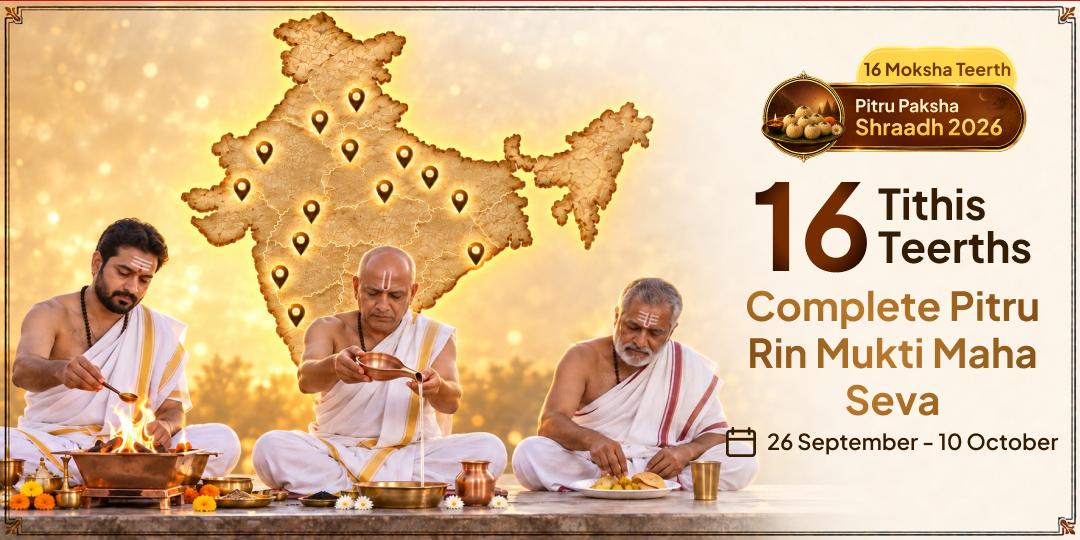
Pitru Paksha Shraddh 16 Tithis 16 Teerths Complete Pitru Rin Mukti Maha Seva
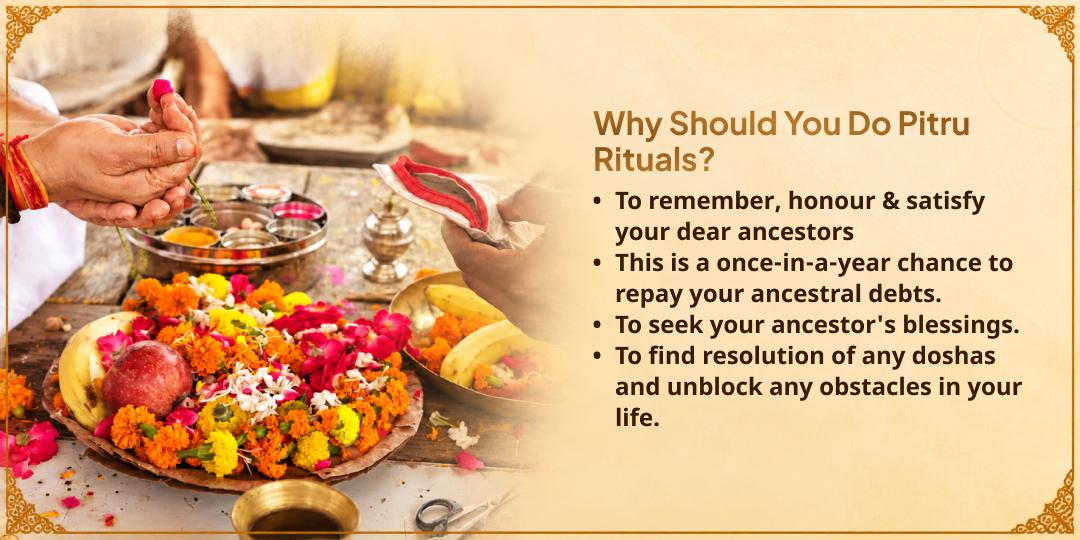
You were born with a debt. No one chose it. No one asked for it. But the Vedas - the most ancient voices of human wisdom - state it clearly. Every human being is born carrying Pitru Rin. The sacred debt owed to the ancestors who gave us life, who built the lineage we carry, who suffered and loved and sacrificed so that we could stand here today. This debt is not a burden to resent. It is the most intimate acknowledgement of what we owe - to those who came before, and to those who will come after.
This Pitru Paksha - for the first time - the complete repayment of that debt is available in one single offering.
Pitru Rin - the debt that binds both the living and the departed.
The Garuda Purana states: "One who does not perform Shraddh rituals remains bound to Pitru Rin - and cannot achieve true progress in this life or the next." But Pitru Rin does not only bind the living. It binds the departed as well - ancestors waiting for the remembrance of their descendants, waiting for the thread of love and duty that connects the generations. When the Pitru Rin Mukti Seva is performed, both are freed simultaneously. You, from the weight of unfulfilled ancestral duty. Your ancestors, from the debt of awaiting that duty's fulfillment. Two worlds. One liberation. Together.
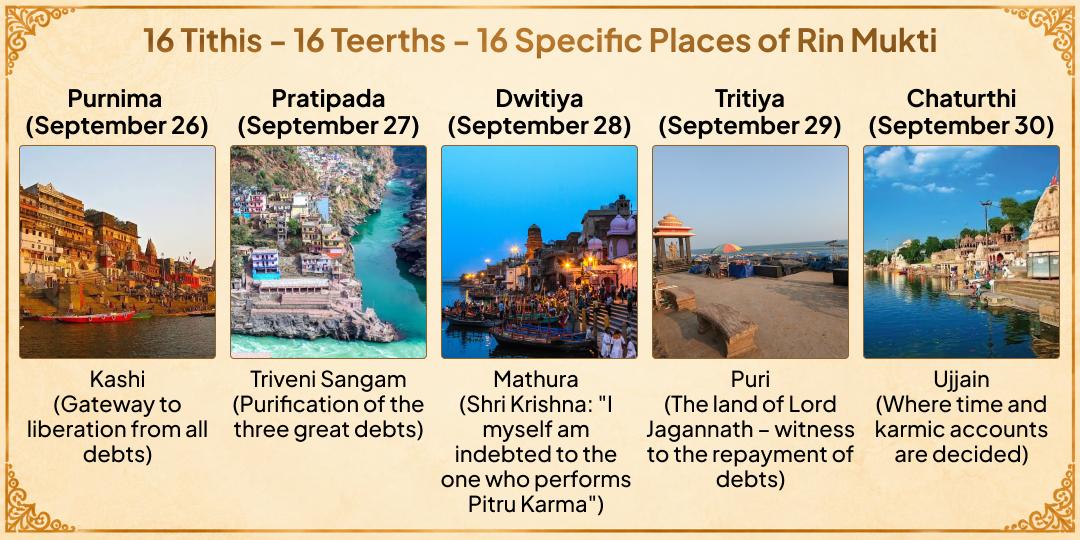
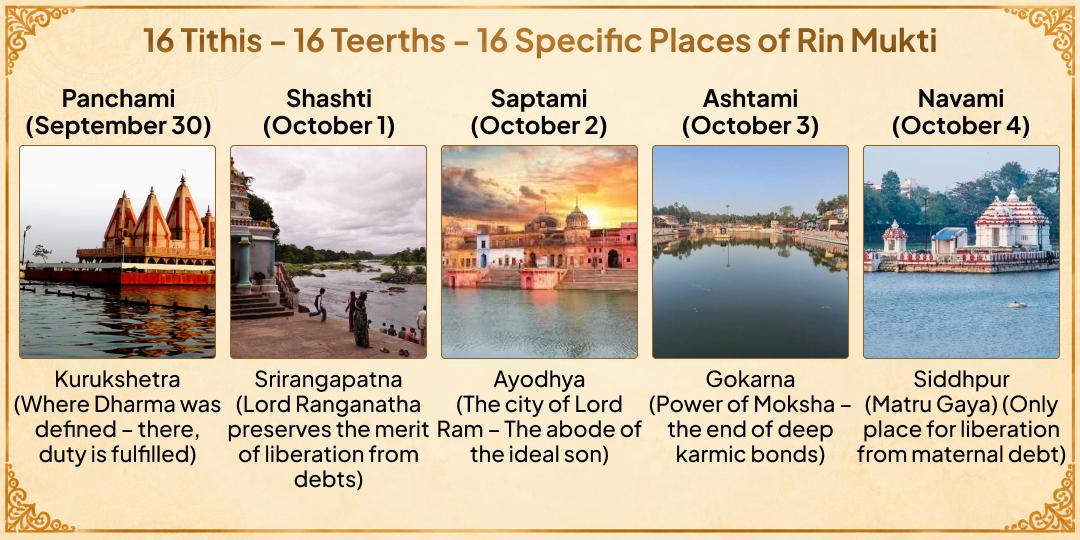
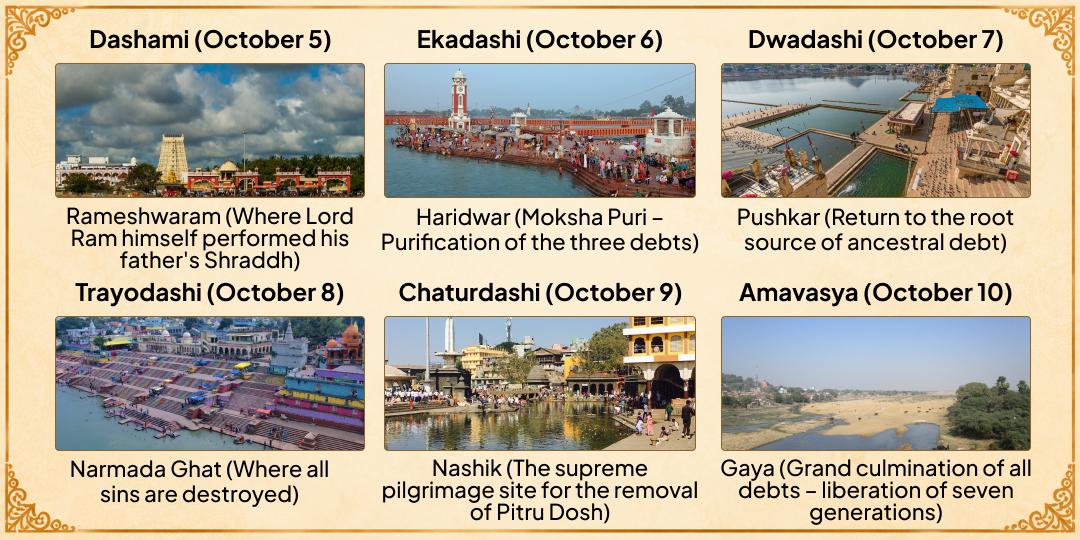
Pitru Paksha has 16 tithis - 16 separate gateways for 16 categories of departed souls. And India has sacred teerths whose specific theological powers correspond precisely to the 16 dimensions of Pitru Rin. When these two completions are aligned - one teertha for each tithi, each with its specific Rin-liberating power - the result is not merely 16 individual acts of seva. It is a complete, unbroken circle of ancestral devotion spanning the entire sacred geography of India.
Purnima at Kashi, Pratipada at Triveni Sangam, Dwitiya at Mathura, Tritiya at Puri, Chaturthi at Ujjain, Panchami at Kurukshetra, Shashthi at Srirangapatna, Saptami at Ayodhya, Ashtami at Gokarna, Navami at Siddhpur - Matru Gaya, Dashami at Rameshwaram, Ekadashi at Haridwar, Dwadashi at Pushkar, Trayodashi at Narmada Ghat, Chaturdashi at Nashik And finally - Amavasya at Gaya - the supreme Pitru Teertha. Travelling to these 16 different teerths across India in 16 days is impossible for any individual or any family. But through Sri Mandir, you can - from wherever you are in the world - have this complete seva performed with Complete traditional vidhi-vidhaan.
16 Sacred Teerths. 16 Holy Tithis. Only with Sri Mandir.


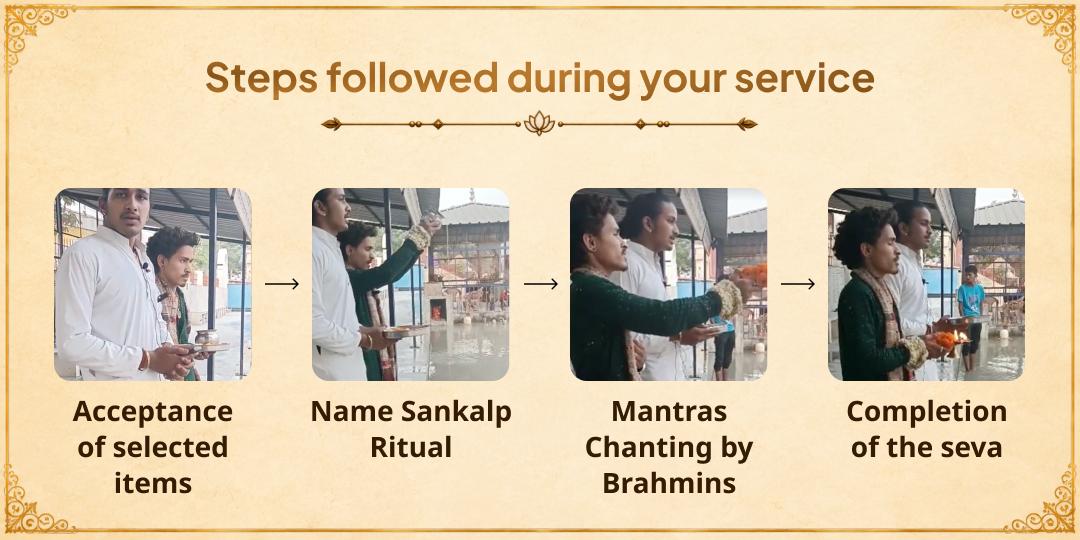
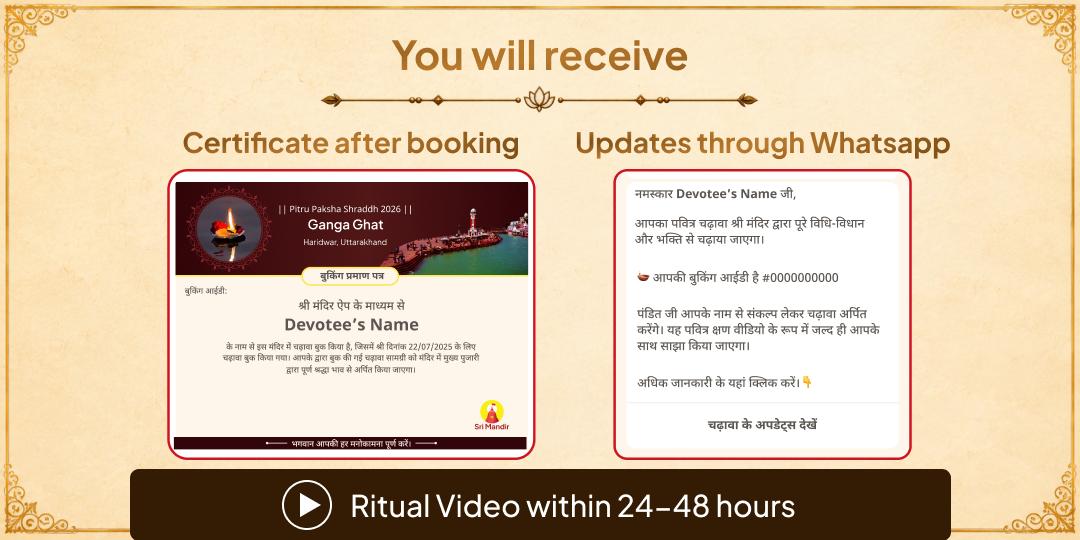
Through the Sri Mandir Chadhava Service App, your offering will be devoutly presented by our experienced Purohits. You will receive a video of the ritual within 24-48 hours, bringing you divine blessings and prosperity.
The Garuda Purana gives a clear account of the method of tarpan and how it reaches them. Jal is offered as anjali along with sesame seeds, kush grass, and the chanting of mantras - the ancestors, positioned in the sky and in the southern direction, receive it there. The scriptures say: "One who performs tarpan with anjali of jal mixed with sesame seeds grants their ancestors satisfaction for many years." The ancestors exist in a subtle body, and it is in that subtle form that they receive the Tarpan.
Don’t worry. If you do not know your gotra, you can write “Kashyapa Gotra” or “Unknown Gotra” - these are considered scripturally accepted alternatives. And if you do not know your ancestors’ names either, you can say in the Sankalp: “May all known and unknown ancestors of my lineage accept this offering.” This is where the unseen flow of the Saraswati River is believed to play its role - carrying the offering to unknown ancestors.
The Garuda Purana states: “Sesame seeds originated from the body of Lord Vishnu.” Therefore, sesame is considered one of the purest and safest offerings. Adding sesame to Tarpan is believed to protect the offering from “demonic obstacles” (Daitya Badha) and help it reach the ancestors directly. Sesame is also considered dear to both Shani Dev and Yamaraj; therefore, sesame-water (Til-Jal) is believed to help pacify both karmic afflictions and Pitru Dosha.
The Garuda Purana clearly states that ancestors reside in Pitru Loka in a “vayu-rupa” (air-like form) and return to their descendants during Pitru Paksha. The ancestors are said to reside in Chandraloka, and during Pitru Paksha, the distance between Earth and the Moon is at its shortest, both scientifically and spiritually. On Purnima, when the Moon is full, the ancestors are believed to be at their most active and receptive. This is the science of Shradh - when a descendant remembers their ancestors with a Sankalp in their name, the invitation is believed to reach that soul.
Every human being is born with five debts, among which Pitru Rin is considered the greatest. If it is not fulfilled through Shraddha and Tarpan during Pitru Paksha, it gradually takes the form of “Pitru Dosha.” To a greater or lesser extent, everyone carries some form of Pitru Rin in their life. However, in families that regularly perform Pitru rituals, this Dosha is believed to remain inactive. In families that have not performed Shraddha for several generations, this Dosha is believed to become more prominent.
Yes, absolutely. It is a major misconception that only men can perform Shraddha. The Ramayana provides an example: when Rama and Lakshmana went to collect the required materials, Mata Sita performed Pind Daan for King Dasharatha alone on the banks of the Phalgu River. This Shraddha was so powerful that Rama’s Sankalp letter became a witness. The verse “Ye ke chasmatkule jata aputta gotravighrahah” clearly indicates that even in the absence of a son, a daughter or any descendant can perform Shraddha.
Yes! Shraddha is not performed only for deceased parents — it can also be performed for grandparents, maternal grandparents, great-grandparents, and any departed ancestor of the family. Even if all three generations are alive, their ancestors (such as great-grandparents) may still be awaiting Shraddha. The Sankalp during Pitru Paksha is always made for “all the ancestors of the lineage.”
Yes, the scriptures give clear permission for this. The list of people for whom Shraddha may be performed at Gokarna includes a teacher, disciple, friend, father-in-law, brother-in-law, maternal uncle, brother, and sister. “Atmiya Jana” — those who were dear to you and whose passing brought you grief — may also be honoured through Shraddha. During Pitru Paksha, take a special Sankalp in their name and perform the rituals for the peace of their soul. There is no limit to love, and Shraddha is considered its highest expression.
If you face any issues with your Service, you can contact our Sri Mandir customer service team at 📞918296948051, who are always ready to assist you.2